Social Cognitive Career Theory (SCCT) represents a comprehensive framework for understanding career development processes within counseling psychology, integrating cognitive, behavioral, and environmental factors that influence career choices and outcomes. Developed by Robert Lent, Steven Brown, and Gail Hackett, SCCT extends Albert Bandura’s social cognitive theory to the career domain, emphasizing the reciprocal interactions between person, behavior, and environment in shaping vocational development. The theory focuses on three core variables—self-efficacy beliefs, outcome expectations, and personal goals—that work together to influence career interests, choices, and performance. SCCT has become instrumental in career counseling practice, providing evidence-based frameworks for understanding how individuals develop career interests, make educational and vocational choices, and achieve career-related outcomes. Research demonstrates the theory’s effectiveness in explaining career development across diverse populations and its utility in designing interventions that enhance career decision-making, academic performance, and vocational satisfaction. The integration of cognitive and social factors makes SCCT particularly valuable for addressing contemporary career challenges and developing culturally responsive career counseling approaches.
Introduction
Career development occurs within a complex interplay of personal characteristics, learning experiences, and environmental factors that shape how individuals form career interests, make educational and vocational choices, and achieve career-related outcomes. Understanding these dynamic processes has been a central focus in counseling psychology, particularly in developing theoretical frameworks that can guide effective career counseling interventions and help individuals navigate increasingly complex career landscapes.
Social Cognitive Career Theory emerged in the 1990s as a response to the need for a comprehensive theoretical framework that could account for the multifaceted nature of career development while providing practical guidance for career counseling practice. Developed by Robert Lent, Steven Brown, and Gail Hackett, SCCT represents a significant advancement in career development theory by integrating insights from social cognitive psychology with established principles of vocational psychology.
The theory’s foundation in Albert Bandura’s social cognitive theory provides a robust theoretical base that emphasizes human agency, the importance of cognitive processes, and the reciprocal interactions between personal factors, behavioral patterns, and environmental influences. This triadic reciprocal causation model offers a sophisticated understanding of how career development unfolds through the dynamic interaction of these three domains.
SCCT’s relevance to contemporary career counseling practice stems from its emphasis on cognitive factors that can be addressed through intervention, its attention to environmental and contextual influences on career development, and its recognition of the ongoing nature of career development throughout the lifespan. The theory’s focus on modifiable factors such as self-efficacy beliefs and outcome expectations makes it particularly valuable for designing interventions that can enhance career development outcomes for diverse populations.
Theoretical Foundations and Core Concepts
Social Cognitive Theory Foundation
Social Cognitive Career Theory is firmly grounded in Albert Bandura’s social cognitive theory, which provides a comprehensive framework for understanding human behavior and development. Bandura’s theory emphasizes the importance of observational learning, self-regulation, and self-efficacy in shaping behavior and development. The application of these principles to career development creates a powerful framework for understanding how individuals develop career-related beliefs, interests, and behaviors.
The foundation of social cognitive theory rests on the concept of triadic reciprocal causation, which proposes that personal factors, behavioral patterns, and environmental influences operate as interacting determinants of human functioning. In the career domain, this means that an individual’s career development is shaped by the ongoing interaction between personal characteristics (such as abilities, values, and self-efficacy beliefs), career-related behaviors (such as skill development and career exploration), and environmental factors (such as educational opportunities, social support, and cultural influences).
This theoretical foundation provides SCCT with several key advantages over earlier career development theories. First, it recognizes the active role that individuals play in their own career development through their cognitive processes and behavioral choices. Second, it acknowledges the importance of environmental factors without viewing individuals as passive recipients of environmental influence. Third, it provides a framework for understanding how change occurs in career development through the modification of cognitive, behavioral, and environmental factors.
Core Variables of SCCT
Social Cognitive Career Theory identifies three core cognitive variables that play central roles in career development: self-efficacy beliefs, outcome expectations, and personal goals. These variables work together in dynamic ways to influence how individuals develop career interests, make career-related choices, and achieve career outcomes.
Self-efficacy beliefs represent individuals’ judgments about their capabilities to perform specific tasks or behaviors required to achieve particular outcomes. In the career domain, self-efficacy beliefs relate to confidence in one’s ability to successfully perform career-relevant tasks, educational activities, and occupational behaviors. These beliefs are domain-specific and can vary across different career-related activities and contexts.
Research has consistently demonstrated that self-efficacy beliefs are powerful predictors of career interests, choices, and performance. Individuals with strong self-efficacy beliefs in particular domains are more likely to develop interests in related activities, choose educational and career paths that involve those activities, and persist in the face of challenges and obstacles.
Outcome expectations refer to individuals’ beliefs about the likely consequences of performing particular behaviors. In career contexts, outcome expectations involve beliefs about the outcomes that will result from pursuing specific educational paths or career choices. These expectations can be positive or negative and can relate to various types of outcomes, including material rewards, social recognition, self-satisfaction, and career advancement opportunities.
Personal goals represent individuals’ intentions to engage in specific activities or to achieve particular outcomes. Goals help organize and guide behavior by providing direction and motivation for sustained effort. In SCCT, goals serve as important mediators between self-efficacy beliefs and outcome expectations on one hand and career-related behaviors on the other.
Learning Experiences and Career Development
SCCT emphasizes the crucial role that learning experiences play in the development of self-efficacy beliefs, outcome expectations, and interests. The theory identifies four primary sources of learning experiences that contribute to career development: performance accomplishments, vicarious learning, social persuasion, and physiological and affective states.
Performance accomplishments, or direct experiences of success and failure, are considered the most influential source of self-efficacy beliefs. Successful experiences in career-related activities tend to strengthen self-efficacy beliefs, while failures, particularly repeated failures, tend to weaken them. The interpretation of these experiences is crucial, as the same objective outcome can be interpreted differently depending on various factors such as the difficulty of the task, the amount of effort expended, and the presence of external assistance.
Vicarious learning occurs through observation of others performing career-related activities. Seeing others successfully perform tasks, especially others who are perceived as similar to oneself, can enhance self-efficacy beliefs and shape outcome expectations. Role models play particularly important roles in career development by demonstrating that success is possible and by providing examples of career paths and strategies.
Social persuasion involves encouragement, feedback, and messages from others about one’s capabilities and the likely outcomes of career-related choices. Positive encouragement from significant others can enhance self-efficacy beliefs and promote interest development, while discouragement or negative feedback can have the opposite effect.
Physiological and affective states refer to the emotional and physical reactions that individuals experience in career-related situations. Anxiety, stress, excitement, and other emotional responses can influence how individuals interpret their capabilities and the desirability of different career options.
SCCT Models and Processes
Interest Development Model
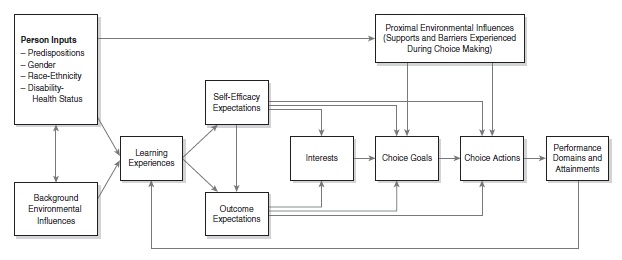
The interest development model is one of the foundational models within Social Cognitive Career Theory, explaining how career interests emerge and evolve through the interaction of self-efficacy beliefs, outcome expectations, and learning experiences. As shown in Figure 1 (center), this model demonstrates the complex pathways through which cognitive and environmental factors combine to shape career interest development.

Figure 1. A simplified view of how career-related interests and choices develop over time, according to social cognitive career theory.
Source: Adapted from R. W. Lent, S. D. Brown, and G. Hackett (1994).
According to this model, individuals develop interests in activities for which they have strong self-efficacy beliefs and positive outcome expectations. The development of these cognitive variables is influenced by learning experiences, which are shaped by both personal characteristics and environmental factors. Personal characteristics include factors such as gender, ethnicity, physical attributes, and predispositions, while environmental factors encompass cultural context, family influences, educational opportunities, and economic conditions.
The model suggests that interests are not simply innate preferences but rather are developed through a complex process of learning and cognitive evaluation. This perspective has important implications for career counseling, as it suggests that interests can be developed and modified through appropriate interventions that enhance self-efficacy beliefs and create positive outcome expectations.
The interest development model also recognizes that the relationship between interests and career choices is not automatic. Environmental factors and personal characteristics can create barriers or supports that influence whether interests translate into actual career choices and pursuits. This recognition is crucial for understanding career development in diverse populations and for designing interventions that address both individual and environmental factors.
Choice Model
The choice model within SCCT explains how individuals make educational and career choices based on their interests, self-efficacy beliefs, and outcome expectations. This model builds on the interest development model by examining the factors that influence whether interests are translated into goals and ultimately into career-related choices and actions.
According to the choice model, career choices are primarily determined by interests, which are themselves influenced by self-efficacy beliefs and outcome expectations. However, the model recognizes that the relationship between interests and choices can be moderated by various contextual factors, including perceived barriers and supports in the environment.
The choice model introduces the concept of compromise, recognizing that individuals may not always be able to pursue their most preferred career options due to real or perceived constraints. These constraints might include limited financial resources, family obligations, discrimination, lack of educational opportunities, or geographic limitations. The model suggests that when individuals encounter significant barriers to their preferred choices, they may modify their goals and make compromises that represent the best available alternatives.
This aspect of the model is particularly important for understanding career development in populations that face systemic barriers or limited opportunities. It highlights the need for career counseling interventions that not only focus on individual factors such as interests and self-efficacy but also address environmental barriers and help individuals develop strategies for overcoming or circumventing obstacles.
Performance Model
The performance model explains how individuals achieve success and satisfaction in their chosen educational and career pursuits. This model focuses on the factors that contribute to performance and persistence in career-related activities, extending beyond the initial choice process to examine ongoing career development and achievement.
According to the performance model, performance and persistence are influenced by self-efficacy beliefs, outcome expectations, and goals, which work together to determine the level of effort individuals invest in career-related activities and their persistence in the face of challenges. The model suggests that individuals with strong self-efficacy beliefs, positive outcome expectations, and clear goals are more likely to achieve success and satisfaction in their chosen pursuits.
The performance model also recognizes the reciprocal nature of these relationships, noting that successful performance experiences can strengthen self-efficacy beliefs and modify outcome expectations, creating a positive feedback loop that supports continued achievement and growth. Conversely, poor performance or negative experiences can weaken self-efficacy beliefs and create negative outcome expectations that may undermine future performance.
This model has important implications for career counseling interventions aimed at helping individuals succeed in their chosen career paths. It suggests that interventions should focus not only on helping individuals make appropriate career choices but also on developing the self-efficacy beliefs, outcome expectations, and goal-setting skills necessary for sustained success and satisfaction.
Applications in Career Counseling
Assessment and Intervention Planning
Social Cognitive Career Theory provides a comprehensive framework for career assessment that goes beyond traditional approaches focused primarily on interests and abilities. SCCT-based assessment examines self-efficacy beliefs, outcome expectations, goals, learning experiences, and environmental factors that influence career development. This comprehensive approach enables career counselors to develop more complete understanding of their clients’ career development needs and to design more targeted and effective interventions.
Career counselors using SCCT principles typically assess self-efficacy beliefs across various career-related domains to identify areas of strength and concern. This assessment might involve formal instruments designed to measure career-related self-efficacy, behavioral observations during career exploration activities, or structured interviews that explore clients’ confidence in their ability to perform various career-related tasks.
Assessment of outcome expectations examines clients’ beliefs about the likely consequences of pursuing different career options. This includes exploring both positive and negative outcome expectations, as well as examining how realistic these expectations are based on available information about different career paths. Understanding clients’ outcome expectations helps counselors identify areas where additional career information might be needed or where unrealistic expectations might need to be addressed.
The assessment of learning experiences focuses on identifying the sources of clients’ career-related beliefs and interests. This exploration helps counselors understand how current beliefs and interests developed and identifies opportunities for creating new learning experiences that might modify or strengthen these beliefs.
Individual Career Counseling Interventions
SCCT principles can be applied in various individual career counseling interventions designed to enhance career development outcomes. Self-efficacy enhancement interventions represent one of the most important applications of SCCT in career counseling practice. These interventions are designed to strengthen clients’ confidence in their ability to perform career-related tasks and achieve career goals.
Self-efficacy enhancement can be accomplished through various strategies based on the four sources of learning experiences identified in SCCT. Performance accomplishments can be created through structured career exploration activities, skill-building exercises, informational interviewing, job shadowing, and internship experiences that provide opportunities for successful performance in career-related contexts.
Vicarious learning experiences can be facilitated through exposure to role models and mentoring relationships. Career counselors can help clients identify appropriate role models, facilitate connections with professionals in fields of interest, and use case studies or biographical materials to provide examples of successful career development.
Social persuasion interventions involve providing clients with realistic encouragement and feedback about their capabilities while also helping them develop more accurate self-assessments. This might include helping clients recognize and challenge negative self-talk or unrealistic self-evaluations that undermine their career development.
Interventions addressing physiological and affective states focus on helping clients manage anxiety, stress, and other emotional reactions that might interfere with career exploration and decision-making. This might include relaxation training, stress management techniques, or cognitive restructuring approaches that help clients develop more adaptive responses to career-related challenges.
Group and Psychoeducational Interventions
SCCT principles are well-suited for group career development interventions and psychoeducational programs. Group formats provide natural opportunities for vicarious learning and social persuasion while also being cost-effective ways to deliver career development services to larger numbers of individuals.
Group interventions based on SCCT principles typically focus on enhancing self-efficacy beliefs, developing realistic outcome expectations, and improving goal-setting and planning skills. These groups might include structured activities such as career exploration exercises, skill-building workshops, goal-setting training, and group discussions about career-related concerns and challenges.
The group format provides opportunities for members to learn from each other’s experiences, provide mutual support and encouragement, and practice career-related skills in a supportive environment. Group members can serve as role models for each other and provide social persuasion that enhances self-efficacy beliefs and motivation for career development activities.
Psychoeducational interventions based on SCCT principles can be delivered in various settings, including schools, colleges, community organizations, and workplaces. These interventions typically focus on providing information about career development processes while also building skills and confidence needed for effective career development.
Research Evidence and Validation
Empirical Support for SCCT Models
Extensive research has provided strong empirical support for the core propositions of Social Cognitive Career Theory across various populations and contexts. Meta-analytic reviews have consistently demonstrated significant relationships between self-efficacy beliefs, outcome expectations, interests, and career-related outcomes, supporting the fundamental assumptions of the theory.
Research on the interest development model has shown that self-efficacy beliefs and outcome expectations are significant predictors of career interests across various domains and populations. Studies have found that these relationships hold across different cultural groups, age ranges, and career fields, supporting the generalizability of the model.
The choice model has received extensive empirical validation, with research demonstrating that interests, self-efficacy beliefs, and outcome expectations are significant predictors of educational and career choices. Studies have also supported the model’s emphasis on the role of environmental factors in moderating the relationship between interests and choices, particularly for individuals from underrepresented groups who may face additional barriers to career development.
Research on the performance model has shown that self-efficacy beliefs, outcome expectations, and goals are significant predictors of academic and career performance outcomes. These relationships have been demonstrated across various educational and occupational contexts, supporting the model’s utility for understanding factors that contribute to career success and satisfaction.
Cross-Cultural and Diversity Research
One of the significant strengths of SCCT is its applicability across diverse populations and cultural contexts. Research has demonstrated that the core relationships proposed by the theory hold across various racial, ethnic, and cultural groups, while also identifying important cultural variations in how these processes unfold.
Studies with racial and ethnic minority populations have generally supported the basic SCCT models while highlighting the particular importance of environmental factors and contextual influences for these groups. Research has shown that perceived barriers and supports play especially important roles in the career development of individuals from underrepresented groups, supporting SCCT’s emphasis on the interaction between personal and environmental factors.
Cross-cultural research has demonstrated that while the fundamental relationships between self-efficacy, outcome expectations, interests, and choices appear to be universal, the specific content and relative importance of these variables can vary across cultures. This research has informed the development of culturally adapted applications of SCCT that take into account cultural values, family influences, and social contexts.
Gender differences in career development have also been extensively studied within the SCCT framework. Research has shown that while the basic models apply to both men and women, there are important differences in the learning experiences, environmental influences, and barriers that men and women encounter in their career development.
Intervention Research
Research on SCCT-based interventions has provided evidence for the effectiveness of approaches designed to enhance self-efficacy beliefs, modify outcome expectations, and improve career development outcomes. Intervention studies have demonstrated that structured programs based on SCCT principles can significantly improve participants’ career-related self-efficacy, career decision-making skills, and career exploration behaviors.
Studies of self-efficacy enhancement interventions have shown that programs incorporating performance accomplishments, vicarious learning, social persuasion, and emotional regulation strategies can effectively strengthen career-related self-efficacy beliefs. These improvements in self-efficacy have been associated with increased career exploration, improved career decision-making, and greater persistence in educational and career pursuits.
Research on interventions targeting outcome expectations has demonstrated that providing accurate career information and creating opportunities for realistic career exploration can help individuals develop more accurate and positive outcome expectations. These interventions have been particularly effective for individuals from underrepresented groups who may have limited exposure to information about various career options.
Comprehensive career development programs based on SCCT principles have shown effectiveness in promoting career development across various populations and settings. These programs typically combine multiple intervention strategies and have demonstrated improvements in career decision-making self-efficacy, career exploration behavior, and career decision-making progress.
Contemporary Applications and Future Directions
Technology and Digital Career Development
The integration of technology into career development services has created new opportunities for applying SCCT principles in digital formats. Online career assessment tools based on SCCT can provide comprehensive evaluation of self-efficacy beliefs, outcome expectations, and interests while offering personalized feedback and recommendations for career development activities.
Virtual reality and simulation technologies offer innovative ways to provide vicarious learning experiences and performance accomplishments that can enhance career-related self-efficacy beliefs. These technologies can provide safe, controlled environments for individuals to explore career options and practice career-related skills without the risks associated with real-world experiences.
Social media and online networking platforms can facilitate connections with role models and mentors while providing access to career-related information and learning experiences. These platforms can extend the reach of SCCT-based interventions by providing ongoing support and resources for career development.
Digital career development programs based on SCCT principles can provide accessible, cost-effective career development services to individuals who might not otherwise have access to career counseling. These programs can incorporate multimedia content, interactive exercises, and personalized feedback to create engaging and effective learning experiences.
Addressing Contemporary Career Challenges
Social Cognitive Career Theory provides valuable frameworks for understanding and addressing contemporary career challenges such as rapid technological change, economic uncertainty, and changing employment patterns. The theory’s emphasis on cognitive factors and learning experiences makes it particularly relevant for helping individuals adapt to changing career requirements and develop skills needed for lifelong career development.
SCCT principles can inform interventions designed to help individuals develop adaptability skills needed for navigating uncertain career environments. These interventions focus on enhancing self-efficacy for learning new skills, developing positive outcome expectations for change and adaptation, and building goal-setting skills that can be applied flexibly as circumstances change.
The theory’s attention to environmental factors makes it valuable for addressing systemic barriers and inequities that affect career development. SCCT-based interventions can focus on both individual skill development and environmental change strategies that address structural barriers to career development.
Career counselors working with individuals in non-traditional career paths, such as entrepreneurs, freelancers, or gig economy workers, can use SCCT principles to help these individuals develop the self-efficacy beliefs, outcome expectations, and goal-setting skills needed for success in less structured career environments.
Limitations and Future Research Directions
Theoretical and Methodological Considerations
While Social Cognitive Career Theory has received extensive empirical support, several limitations and areas for future development have been identified. One limitation concerns the theory’s emphasis on rational, cognitive processes in career development, which may not fully account for the role of emotions, unconscious processes, and intuitive decision-making in career choices and development.
The measurement of key SCCT variables, particularly outcome expectations and learning experiences, presents ongoing challenges. Developing reliable and valid measures of these constructs across diverse populations and contexts remains an important priority for SCCT research.
The theory’s focus on individual factors and cognitive processes, while acknowledging environmental influences, may not adequately address the complex ways that systemic factors, structural inequalities, and social contexts influence career development. Future theoretical development might benefit from greater integration with sociological and critical perspectives on career development.
Integration with Other Career Theories
Future research should examine how SCCT can be integrated with other career development theories to provide more comprehensive understanding of career development processes. The integration of SCCT with theories such as Super’s life-span theory, Holland’s theory of vocational personalities, or chaos theory of careers could provide richer frameworks for understanding career development.
Research examining the relationships between SCCT variables and constructs from other theoretical frameworks could inform the development of more comprehensive career development models that account for multiple factors and processes involved in career development.
The development of integrated theoretical models that combine SCCT principles with insights from positive psychology, multicultural psychology, and other relevant fields could enhance the theory’s applicability and effectiveness.
Conclusion
Social Cognitive Career Theory has emerged as one of the most influential and well-validated frameworks in contemporary career development theory and practice. Its integration of cognitive, behavioral, and environmental factors provides a comprehensive understanding of how career interests develop, how career choices are made, and how career success and satisfaction are achieved. The theory’s grounding in social cognitive theory provides a solid theoretical foundation while its emphasis on modifiable factors makes it highly relevant for career counseling and intervention.
The extensive research base supporting SCCT demonstrates its applicability across diverse populations and contexts while also highlighting areas where cultural adaptations and modifications may be needed. The theory’s flexibility and comprehensiveness make it valuable for addressing contemporary career challenges while its emphasis on cognitive factors provides clear targets for intervention.
SCCT’s contributions to career counseling practice are substantial, providing frameworks for assessment, intervention planning, and program development that have been shown to be effective in promoting career development outcomes. The theory’s emphasis on self-efficacy beliefs, outcome expectations, and goal-setting provides career counselors with practical tools for helping clients overcome barriers and achieve their career aspirations.
Future developments in SCCT will likely focus on enhancing its applicability to diverse populations, integrating it with other theoretical frameworks, and adapting it to address emerging career challenges in an increasingly complex and rapidly changing world of work. The continued evolution and refinement of SCCT will ensure its continued relevance and utility for understanding and facilitating career development in the 21st century and beyond.
References
- Bandura, A. (1986). Social foundations of thought and action: A social cognitive theory. Prentice Hall. https://www.pearson.com/store/p/social-foundations-of-thought-and-action-a-social-cognitive-theory/P100000659447
- Bandura, A. (2006). Guide for constructing self-efficacy scales. In F. Pajares & T. Urdan (Eds.), Self-efficacy beliefs of adolescents (pp. 307-337). Information Age Publishing. https://www.infoagepub.com/products/Self-Efficacy-Beliefs-of-Adolescents
- Brown, S. D., & Lent, R. W. (2016). Vocational psychology: Agency, equity, and well-being. Annual Review of Psychology, 67, 541-565. https://doi.org/10.1146/annurev-psych-122414-033237
- Brown, S. D., & Lent, R. W. (Eds.). (2005). Career development and counseling: Putting theory and research to work. John Wiley & Sons. https://www.wiley.com/en-us/Career+Development+and+Counseling%3A+Putting+Theory+and+Research+to+Work-p-9780470475280
- Hackett, G., & Betz, N. E. (1981). A self-efficacy approach to the career development of women. Journal of Vocational Behavior, 18(3), 326-339. https://doi.org/10.1016/0001-8791(81)90019-1
- Lent, R. W. (2005). A social cognitive view of career development and counseling. In S. D. Brown & R. W. Lent (Eds.), Career development and counseling: Putting theory and research to work (pp. 101-127). John Wiley & Sons. https://www.wiley.com/en-us/Career+Development+and+Counseling%3A+Putting+Theory+and+Research+to+Work-p-9780470475280
- Lent, R. W., & Brown, S. D. (2013). Social cognitive model of career self-management: Goals, interests, and subjective well-being in relation to work. Journal of Counseling Psychology, 60(4), 557-569. https://doi.org/10.1037/a0033446
- Lent, R. W., Brown, S. D., & Hackett, G. (1994). Toward a unifying social cognitive theory of career and academic interest, choice, and performance. Journal of Vocational Behavior, 45(1), 79-122. https://doi.org/10.1006/jvbe.1994.1027
- Lent, R. W., Brown, S. D., & Hackett, G. (2000). Contextual supports and barriers to career choice: A social cognitive analysis. Journal of Counseling Psychology, 47(1), 36-49. https://doi.org/10.1037/0022-0167.47.1.36
- Lent, R. W., Hackett, G., & Brown, S. D. (1999). A social cognitive view of school-to-work transition. The Career Development Quarterly, 47(4), 297-311. https://doi.org/10.1002/j.2161-0045.1999.tb00739.x
- Rottinghaus, P. J., Lindley, L. D., Green, M. A., & Borgen, F. H. (2002). Educational aspirations: The contribution of personality, self-efficacy, and interests. Journal of Vocational Behavior, 61(1), 1-19. https://doi.org/10.1006/jvbe.2001.1843
- Sheu, H. B., Lent, R. W., Brown, S. D., Miller, M. J., Hennessy, K. D., & Duffy, R. D. (2010). Testing the choice model of social cognitive career theory across Holland themes: A meta-analytic path analysis. Journal of Vocational Behavior, 76(2), 252-264. https://doi.org/10.1016/j.jvb.2009.10.015
- Swanson, J. L., & Gore, P. A. (2000). Advances in vocational psychology theory and research. In S. D. Brown & R. W. Lent (Eds.), Handbook of counseling psychology (3rd ed., pp. 233-269). John Wiley & Sons. https://www.wiley.com/en-us/Handbook+of+Counseling+Psychology%2C+4th+Edition-p-9780470096222
- Worthington, R. L., & Roehlke, H. J. (1979). Effective supervision as perceived by beginning counselors-in-training. Journal of Counseling Psychology, 26(1), 64-73. https://doi.org/10.1037/0022-0167.26.1.64